Florida Real Estate Taxes and Their Implications: What You Need to Know

Real Estate Taxes
In many parts of the world, it is common to pay taxes in some form. In Florida, there is no state income tax as there is in other US states. But if you do make money from renting or when you sell your property there will be Federal taxes (to the US government) to pay on the profit. There is also the annual tax on the value of the property that you own.

Before we begin, we would like to strongly advise all non-resident buyers to invest a few hundred dollars to meet with a Florida Tax Accountant who has a breadth of experience working with international clients. It’s one of the most important things to understand when buying real estate in another country, as the tax costs could drastically affect your projected return on investment.

A professional accountant will be able to help you understand your own unique tax situation and make sure you are compliant with all aspects of tax law. In many cases, the tax to pay may be zero, but the costs of not filing or defaulting may be much higher.

Because an international buyer’s overall tax liability may be different than that of a US resident, depending upon the buyer’s home country’s tax treaty with the US We also think it is best to consult a tax advisor within your home country that is familiar with the tax treaty.

For instance, the capital gains rate for US residents is 15-20 percent (if the property was owned for more than one year). Foreign nationals, however, could be required to pay a higher rate, depending on their home country’s tax treaty with the US a tax accountant within your home country, who is familiar with your home country’s treaty, would be the best resource for answers to these questions.

Three Types of Taxes Relating to Florida Real Estate

  • First, all properties in Florida are assessed a taxable value and owners pay an annual Florida property tax based on this value (except churches, schools, government entities). This tax is paid to the local municipality
  • Second, if you sell your home, there may be a capital gains tax on the profit realized from the sale. For this scenario, there are federal guidelines set forth for global buyers under the Foreign Investment in Real Property Tax Act (FIRPTA).

Because FIRPTA is a rather complex Act, we discuss it at length in our article FIRPTA and the Case of the Foreign Seller. We strongly recommend global buyers reference this article. Furthermore, it is something you should definitely be aware of for your future tax planning purposes, especially since it is an important topic to discuss with your tax advisor in your initial meeting.

  • The third tax category only applies to rental properties. If there is net profit on the rental income, there may be a federal tax on the profit generated from renting out a vacation home or other investment property. In addition, for short-term rentals, there is a sales tax which is generally charged to the renter and submitted to the local government.

In this section we will discuss Florida property tax, since it is applicable to all property owners on a recurring annual basis and capital gain tax, as it is applicable to all property owners when considering the sale of their property.

Florida Property Tax

In Florida, property taxes go towards public schools and infrastructure, including roads, libraries, and medical services. The local county property appraiser sets the assessed value (based on market data of the prior calendar year) to your property as of January first of each year.

In our experience, there seem to be some significant misunderstandings regarding Florida property taxes. The tax rates are determined by the local municipality and are the same for a property regardless of who owns the property.

There are a handful of opportunities to slightly reduce the property value but not the tax rate itself. For example, property owners who are widowers/widows or are disabled veterans may receive a credit against taxes owed. However, in order to be eligible, the property must be the primary residence of the primary owner — not a second home or rental property.

The Florida statutes direct how each county determines property values. That value is published/released around late summer each year. Each county has its own website defining the process for its residents, so you can look this up for your particular location.

You can visit the website of the Florida Department of Revenue for this information and more.

Florida Property taxes are not due until March first. However, you can begin to pay from the first of November of the tax year. For each month that you pay in advance (for a total of four months), you receive a one percent discount on your total tax bill (for a maximum total discount of four percent).

For example, if your property tax is $4000, by paying in November you save $160.

If you do decide to make Florida your primary residence, you will be entitled to a slight reduction (up to $50,000) in the assessed value of your property plus the assessed value cannot increase by more than 3% in any one year (Save Our Homes Act), thereby reducing your property tax, through something called the Homestead Exemption.

Tax form 1040

Capital Gains Tax

Like many countries, one of the ways the U.S. Government generates its income is by taxing the profits on the sale of real estate investments made within the country. This is a type of capital gains tax, which applies to citizens and non-citizens alike, who sell investment property (the sale of a primary residence is handled differently).

Capital gains tax is effectively tax you pay on the profit you’ve made on your property’s appreciation since you bought it. The capital gains tax is calculated on the profit made from the sale of real estate. The profit is revenue (sale price less purchase price) minus expenses. An accountant will guide you as to what qualifies as expenses.

💡 Pro Tip
We advise that you keep very accurate records of the costs associated with the purchase and sale of your property and everything in between. This may include things that are not as obvious such as travel expenses to visit your property.

The capital gains tax rate applied to your profit will depend on how you hold title and the amount of profit that you will generate. For more information on how you hold title and why it matters, see our article “Taxes And Titles: The Name on Your Property’s Title Matters.”

Tax Returns and Refunds: A Few Things To Consider

Regardless of whether you are a U.S. citizen or a foreign investor, the IRS requires you to file a tax return upon the sale of your property. If you are due a refund, be aware that the IRS begins processing tax returns and refunds at the beginning of the next calendar year.

1031 Exchange

A 1031 Exchange is a mechanism for real estate investors to delay (or defer) taxes on the gain they realized from the sale of their real estate investment. This mechanism is available to all owners/sellers of real estate in the U.S.

For all sellers that want to defer their capital gain, they are required to:

  1. Place the proceeds of the sale into an escrow account of a qualified intermediary
  2. Identify up to three properties targeted for investment within 45 calendar days of the sale of the prior investment
  3. The investor must close on the purchase of one of those three properties within 180 calendar days of the sale of the prior investment.

Generically, these are the basic steps for all investors. There is a fee for the 1031 Exchange and global investors will also have to comply with the FIRPTA requirements in addition to the general investor requirements. However, in our experience, 1031 exchanges are straightforward to facilitate.

When you are contemplating the sale of your investment property, work with your accountant and Realtor to figure out if in your situation it makes sense to do a 1031 exchange, or if it would be better to simply pay the taxes on the profit. Once you calculate each financial scenario and take into account your personal objectives, it usually will be pretty clear which is the better option for your personal situation.

Final Points on Capital Gains Tax Advantages for Residents

In the U.S., a married couple is able to earn $500,000 on the sale of their primary residence tax-free. If you are single this number is $250,000. One way to realize a non-taxable gain is by making your U.S. home your primary residence.

Obviously, if this is the case, you must have an applicable residency visa. If you are a resident in your house for 183 days per year, or two years out of a five-year period, and have owned the property for at least two years, then each resident owner is entitled to $250,000 in tax-free earnings.

As a working example: if you purchased a home for $500,000 as a couple, and two years later sell it for $1 million, then the $500,000 gain can be split between two resident spouses as income, and there will be no tax on that gain.

Knowing Your Residency Status for Tax Purposes: The 183 Day Rule

You can be taxed for U.S. income tax purposes either as a resident or as a non-resident. Residents are required to report their worldwide income to the U.S. taxing authorities. Non-residents are required to report only income arising from U.S. sources.

There are several ways you can be treated as a resident for U.S. income tax purposes. U.S. citizens are always U.S. income tax residents, regardless of where they live. Under most circumstances, an individual who obtains a Green Card (which allows the holder to reside permanently in the U.S.) will be taxed as a resident.

Even if you are not a U.S. citizen, you could be determined to be an income tax resident in the U.S. merely by the number of days in which you are physically present in the U.S. during the current calendar year, or a combination of days over the last three years. If you’re physically present in the U.S. for 183 days or more in a calendar year, you are treated as a U.S. income tax resident.

Although all of this information may seem intimidating at first, a good realtor with a well-established network should be able to put you in contact with the professionals you need to make sure that you understand the rules and can enjoy your new Florida home worry-free!


Why Buy Florida Investment Property?

Family enjoying their FL investment property
There are so many places around the world to spend your money. So many hotspots to snap up a deal on investment property, so why choose Florida? Most people think they know what Florida’s about, but some of the reasons to invest your money here might surprise you.

1) Incredible Climate

The state of Florida boasts one of the most wonderful climates in the world. You likely already know the weather’s pretty good – it being called the Sunshine State and all – but did you know that we have an average of 300 days of sunshine per year? Even in the months of January and February, Florida offers blue skies and warm days. In fact this past February 1st the temperature in Miami was 79 degrees Fahrenheit!

For those of you coming from colder climates – where you’re lucky to see the sun for six months of the year – that’s pretty impressive. Add to that year-round swimmable, crystal clear waters, some of the best beaches in the world, and an abundance of natural flora and fauna, and you really have a climate that facilitates dream living.

2) A Huge Tourism Market – Growing Year on Year

When you invest in Florida property you are investing in a strong and growing tourism market. The United States Commerce Department’s National Travel and Tourism Office has as its goal to welcome 100 million global visitors each year by the end of 2021. Estimates are that these visitors will spend $250 billion during their stay.

For investors looking to make a return by renting their home short term to vacationers, there are few better places to do it than in Florida, and especially in Sarasota. You are buying in a state which welcomed 89.3 million visitors in 2012 and expects that number to increase by 5% this year.

That number includes 10.2 million overseas visitors, up 9% on the previous year. What this means, and what the numbers say loud and clear, is that Florida is a thriving tourism economy. Add to that the fact that the state’s service sector is highly geared towards tourism, and you have a package of great returns and holiday properties that are easy to manage from abroad.

3) Transparency & Ease of Process in Real Estate Transactions

With the right advice and guidance, you will find that Florida is one of the easiest places in the world to buy investment property. Real estate transactions are highly transparent and efficient. Timelines and processes are clearly defined, and most contracts offer a “time is of the essence” clause- meaning parties responsible for the transaction must work in a timely manner.

Florida is also one of the few places in the world to have title insurance: which means your title is 100% guaranteed rock solid. No one can ever claim they own your property, and that is backed up by a cast-iron guarantee from the title insurance company. This is a marked contrast to many European countries, where tracing the ownership of a property can be onerous and in some cases virtually impossible, which means you can never be 100 percent certain of your ownership.

4) Competitive Pricing & Great Returns

From talking to clients and people on our travels one of the biggest misconceptions about Florida investment property is that it’s expensive. While it’s true that there are mega-mansions costing tens of millions for sale, it’s also true that Florida has some incredibly affordable properties…in some cases beginning as low as $100,000. Add to that great returns that are achievable in Florida investment property, and you may find yourself enjoying free holidays as well as generating income. A win-win situation.

You can find out all the information you need on buying your Florida holiday home or property investment from our book “Your Guide to Florida Investment Property.”

Alternatively, click the button below to be put in touch with one of our hand-selected team of Realtors, who can advise you on location and lifestyle, and suggest properties that suit your needs.

What Kind of Florida Homeowners Insurance Do You Really Need and Why?

Home Owners Insurance Guide
With so many types of insurance out there, it can be confusing to understand your choices. Here we share with you what is important to know regarding Florida homeowners insurance so you don’t get caught unprotected.

Here’s How It All Shakes Out

Florida Homeowner’s Insurance

Homeowners insurance helps pay to repair or rebuild your home and replace personal property due to a covered loss. A typical policy would include loss from theft and structural damage from fire, leaks, water discharge, fallen trees, or as a result of a storm.

In our experience, the majority of claims tend to be for water leaks; from air conditioning systems, water heaters, plumbing, and roofs, rather than the more dramatic possibilities.

Mortgage lenders usually require homeowners insurance as part of the mortgage terms. If you are getting financing you must at a minimum have a basic policy.

Most policies include coverage for the house itself, as well as for the property inside the house.

Key Components of the Standard Homeowners Insurance Policy Include:

  • Dwelling
  • Other Structures (shed, detached garage…)
  • Personal Property
  • Loss of Use/Additional Living Expenses (if your house is uninhabitable after a covered loss)
  • Personal Liability (if someone claims you caused them injury or property damage)
  • Medical Payments (to others)

When you own a condominium, the structure will usually be insured by the condominium association and you will pay a portion of that cost through your association fees. You may then only need a policy that insures the interior portion— also known as “improvements and betterments”, that is, of your unit and the contents of your condo.

Typically insurance policies include a “deductible” or excess, which is the amount of money that the homeowner contributes to the repair or replacement cost of the property. Generally, the higher the deductible/excess the lower the annual premium.

Be sure you thoroughly review the type of policy you purchase and ask any questions. It is important to have the proper insurance and understanding of what you purchased.

In addition to the standard coverage, you may want to discuss the relevance of additional coverage. Some examples include identity fraud, pet liability, pool cages, and screen enclosures, mold, sewer backup, or valuable items such as jewelry.

Wind Policy: What To Know So You Don’t Get Blown Away

palm tree in a tropical storm Wind or windstorm insurance generally is included as part of your Homeowners Insurance, but we want to discuss the topic a bit more thoroughly here as we consider it an important aspect of your policy to understand.

In much of Florida, we are susceptible to tropical storms or hurricane-force winds. As such, we guide our clients to ensure they are fully informed about the wind coverage that is included in their insurance package.

This includes providing them with information on how to help protect their home from damage, potentially reducing the costs of this portion of the insurance in the first place.

Protecting your home may even reduce the payout towards your deductible/excess.

Building Codes and Wind Policy: How Hurricane Andrew Changed Everything!

After Hurricane Andrew hit south Florida in 1992, municipalities around the state of Florida created higher standards to better protect homes from damage from winds and wind-borne debris. We refer to these as building codes.

These building codes include improved methods for attaching the roof to the house, reinforcing garage doors, installing windows that can withstand debris hurled at greater speeds, etc. The benefit of living in a home built to newer codes (or retrofitted with these features) is both a safer home and lower costs of insurance.

Older homes are more susceptible to wind damage as they are not made to resist as much wind as the newer builds. Examples of the types of damage that can occur from excess wind are having the shingles or roof ripped off, windows smashed from flying debris, garage doors or walls knocked down.

Many older homes have incredible charm, character, and features that newer homes may not have, so we are not discouraging you from looking at older homes, we just want you to know that there are measures you can take to help protect your home and reduce insurance costs.

Some examples would be to install new windows that have impact glass or hurricane shutters. You can have hurricane straps added to your roof system and also install a new impact-resistant garage door.

Building codes and building materials are both continually evolving. Have your Realtor, insurance professional, and home inspector help you understand the different trade-offs and costs associated with the different options.

Here’s an example to further explain this point:
You want to install a set of storm shutters (protection for windows and doors) and the cost is estimated at $6000, and you learn it will reduce your premium by $3000 per year. Most would consider this a good investment because the payback is 2 years. However, if the same shutters cost $150,000 then the payback would be 50 years and probably not a good investment.

The World Meteorological Association will name any storm that has sustained winds over 39 mph. With wind insurance, a standard deductible/excess is two percent for a named storm. For any other storm, the deductible you have pre-chosen in your contract will apply.

It is commonplace for the wind policy to use a percentage of the total coverage limit rather than a flat cost. For example, a wind policy for $250,000 with a two percent deductible/ excess means the insured pays the first $5,000 of repairs.

Again, you can choose the amount of deductible/excess based on where you are and how much you are willing to pay in premiums. Note, however, that sometimes the mortgage company may limit the amount of deductible/excess you are allowed to have on the policy.

Flood Insurance: How To Stay Above Water

Flood insurance in Florida

A flood insurance policy protects your home against potential flood damage. The question of whether a property is in a flood zone comes up all the time from buyers. Even within our own real estate profession, however, many do not know how to respond accurately.

In the past few years, there have been numerous legislative and rate changes for homeowners’ flood policies due to the National Flood Insurance Program (NFIP). Even information from the current seller of a property—especially if they have an older home—may not be applicable as they may themselves not be aware of how their property has been affected by the changes.

The bottom line? It is best to consult a trusted insurance professional at the very start of the due diligence process with any property you put under contract, to get an accurate flood insurance quote and explanation of flood zones.

When and Where It Can Flood

Let’s dive into some basic explanations to help you get oriented to this topic in very simple terms.

Anywhere it rains, it can flood!

There are two main types of flooding. The first scenario occurs when there is a tropical storm or hurricane that produces a tidal surge: such as when water from the Atlantic Ocean or the Gulf of Mexico moves over the beach and onto normally dry land.

The second happens with heavy, rapid rainfall when storm waters have nowhere else to go. In other words, the water drainage systems, lakes, rivers, and streams cannot absorb excess water fast enough and so it overflows onto land, streets, car parks, or neighborhoods and then into homes.

Other conditions such as an outdated or clogged drainage system, or new development (a building, car park, or road) may also change the ability of the land to absorb excess precipitation and can result in a flood.

What Are Flood Zones?

Every area in the United States is classified as a flood zone. What does that mean? Everyone lives in a flood zone — it’s just a question of the degree of severity of the risk. You may live in a low, moderate, or high-risk area.

While most perceive that the closer you are to bodies of water the greater the risk, there are more factors that come into play. You can be in an area of the mountains and experience flooding because the water flowing from higher levels pools faster than it can drain or be absorbed.

While there are many codes used to define flood zones, there are two main categories: Special Flood Hazard Areas and Preferred Flood Zones.

What is a Special Flood Hazard Area

Areas that are at high risk for flooding are called Special Flood Hazard Areas (SFHAs). Most, if not all barrier islands around Florida are considered SFHAs, as are areas close to the coast and other bodies of water.

If you are in an SFHA and you are financing your property, flood insurance is required. If you pay cash it is optional, but again highly recommended. We personally advise everyone to get flood insurance.

If you are in a Special Hazard flood zone, an Elevation Certificate will be required to determine how high above or below the Base Flood Elevation (BFE) you are.

BFE is the height, relative to the mean sea level, that has a one percent chance or greater of flooding in a given year as determined by FEMA and adopted by your local jurisdiction.

Rates will go up sharply for each foot you are below the BFE and will go lower for each foot you are above the BFE.

Where we live in Sarasota, all new homes within Special Hazard flood zones are required to be built with the first living floor at or above the Base Flood Elevation. This applies even to non-waterfront property.

Insurance professionals refer to Flood Insurance Rate Maps (FIRMs) to be able to identify which type of flood zone a property falls within based on its address. These maps are constantly being updated due to changes in geography, construction and mitigation activities, and meteorological events.

Therefore, even though you may find sites available to the general public online that give flood zone codes, for truly accurate information you must contact your insurance agent or mortgage broker. These are the two parties who by contract have access to the definitive mapping site.

Other Factors To Consider

Another complexity that may affect flood insurance rates is the value and location of appliances/equipment in and around the house that serves the home. Insurance companies may want to know how elevated the appliances are inside or outside the home, how many stories exist in the home, and where the main living areas are.

Florida homeowners are able to purchase flood insurance through various providers, but by virtue of the National Flood Insurance Program (NFIP), the federal government has standardized the rates so your annual cost will be the same irrespective of what insurance company you choose.

Currently, the maximum coverage available through the NFIP is $250,000 for the structure and $100,000 for the contents. The current annual cost if you are in a Preferred Flood Zone and is $414, with a $1000 deductible/excess for each claim.

One of our German clients purchased a home in 2013 on a barrier island about 200 meters from the Gulf of Mexico. Even though his home is in a Special Hazard Zone, he currently pays about $404 per year. The home was built in 2006 and the first living level (air conditioned space) is roughly eight feet above the base flood elevation.

Flood insurance normally requires a 30 day waiting period from the time you sign up before the coverage is effective. Exceptions are only made for certain circumstances such as if you’re purchasing a home and there is a loan being taken out to finance the purchase.

You can find more details about The National Flood Insurance Program at: www.floodsmart.gov

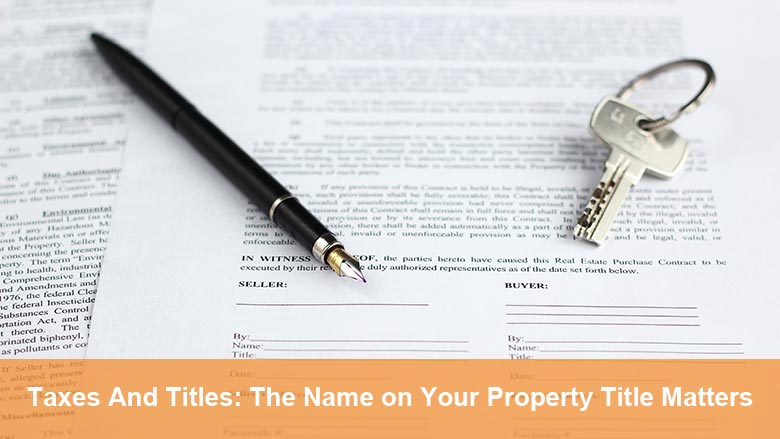
Taxes And Titles: The Name on Your Property Title Matters

Florida Taxes and Titles
There are several options for how to hold title on your Florida real estate. However, if you are financing, you only have one option. Lenders require your property title to be in the individual’s name(s).

If you pay cash, some of the more common ways you can elect to hold title are as an individual, as a U.S. or foreign corporation, as a limited liability corporation (LLC), or as a trust.

How You Hold Title Determines Your Property Tax Liability

We want to begin by emphasizing two key points:

  • First, the biggest consideration for how to set up your property title is how each scenario will affect your tax liability, especially capital gains and estate tax. Estate tax (tax on your right to transfer property at your death) can be particularly onerous if not planned for up front.
  • Second, the tax codes are generic, so it is really important to find out how your specific situation may be affected based on the tax treaties that exist between the U.S. and your home country. Many countries have tax treaties with the U.S., which can reduce or eliminate certain tax obligations in/to the U.S.

Each form of ownership has its tradeoffs—some large, some small. Our advice, as always, is to make an informed choice. Everyone’s financial and personal circumstances are unique; it’s worth investing the few hundred dollars to find out whether the pros of using an LLC or foreign corporation to hold ownership make sense for you.

Below we illustrate some of the tax advantages and disadvantages of the most commonly used ways to own U.S. real estate available to nonresidents.

Tax form 1040

Property Title and Individual Ownership

Taking title in the individual’s name is the most frequently used option for holding property title. Its advantage is that it is the method that results in the least amount of U.S. income tax when a property is sold.

If the property is held for at least one year before it is sold, the maximum tax is calculated at 15-20 percent (depending on the individual’s tax bracket) of the profit. If the net income from any one year is greater than $250,000 there is an additional 3.8 percent tax on the gain.

However, this could be the most disadvantageous way of holding title if the non-resident dies while still owning the property. The estate tax is assessed on the fair market value of the property at the date of death of the owner. It is payable to the IRS no later than nine months after the date of death and, if not paid in a timely manner, it is subject to penalties and interest, which are payable in addition to the estate tax.

For non-US residents, the estate tax applies to property valued in excess of $60,000. The marginal rate for the estate tax imposed on the estate of decedents dying after December 31, 2012 is 40 percent.

U.S. Corporate Ownership

Non-residents are eligible to take title to U.S. real estate in the name of a US corporation. Unlike individual ownership, the corporation does not get the preferential capital gains tax rate of 15 percent or 20 percent (depending on one’s tax bracket) on long-term capital gains.

If the property is located in Florida, then there is a state corporate income tax of 5.5 percent of profit in excess of $5,000 that must also be paid. The overall highest federal income tax rate for property in Florida held through a US corporation is approximately 38 percent.

Compared to the maximum individual tax rate of 15%-20% on the sale of the property, the corporate income tax rate is very high. This is obviously a disadvantage of U.S. corporate ownership of real estate.

The potential advantage of US corporate ownership of US real estate is from the standpoint of US estate taxes. Although the value of shares in a US corporation owned by a non-resident is generally subject to US estate tax upon the death of the owner, estate tax treaties with certain countries (for example, United Kingdom and Germany) provide for an exemption of these shares from the US estate tax. This can be a substantial benefit for those non-residents who qualify.

Foreign Corporate Ownership

This is a fairly rare method to hold title and brings with it some complications. But is worth knowing about as it may suit your unique personal situation, especially if you are older, don’t have an income as such, and are seeking to avoid estate tax.

The foreign (non-US) corporation is subject to the same income tax rates as the US corporation. The advantage of the foreign corporation lies with the U.S. estate tax. Unlike the US corporation, all nonresidents are exempt from US estate tax upon their death if the property title is held by a foreign corporation. The country of residence of the owner is irrelevant.

US Limited Liability Corporation Ownership

US limited liability companies have become increasingly popular as an alternative for ownership of US real estate by non-residents, due to their extreme flexibility.

The limited liability company is a legal entity. The taxability of a limited liability company is dependent on several factors. A limited liability company with two or more members is taxed as a partnership, unless it has elected to be taxed in another manner, such as a corporation.

If the limited liability company has only one member and it has not elected to be taxed as a corporation, then it is treated, for income tax purposes, as a “disregarded entity” and the owner is taxed directly.

For example, if the owner of a single-member limited liability company is a foreign individual, then the rules and tax rates applicable to foreign individuals will apply. The single-member limited liability company will provide the owner with limited legal liability, but it will be taxed in the US for income and estate tax purposes as if the company did not exist.

Because there are so many variables involved, it is critical that you understand your options and how they relate to your given circumstances when it comes to deciding how to hold title on your new Florida property.

Your real estate agent should be able to put you into contact with an accredited tax consultant to find out what will ultimately make the most sense for you before you buy so that your transition into your new Florida home is smooth and worry free.

Do I Need a Visa to Buy Property in the US?

visa application
Before we dive into the riveting topic of immigration and visas, we want to make a few main points. The US welcomes and encourages investment from abroad. Although there are a few steps to follow with regard to visa paperwork, it is easy and efficient to get those boxes ticked these days!

According to the US Department of State, there are 65 million visitors to the US each year. Nowadays, the process for applying for the many types of visas is quite straightforward. The US Commerce Department’s National Travel and Tourism strategy is to welcome 100M international visitors each year by end of 2021!

First, we would like to make it clear for our readers who often ask “Do I need a visa to buy property in the US?”. To own real estate in Florida you do not need any special documentation. If you can get your money into the US, you can invest.

Second, if your aim is to spend time in Florida enjoying the sun, sea, and mild winters, you can expect three months (the time period most visitors are initially approved for) to go by very quickly. This is why we find many global buyers opting for the 6-month temporary visa so that they can settle in longer and/or visit more often and enjoy the Florida lifestyle and climate.

Third, a very popular strategy for many global buyers looking to move their families to the US — whether for financial, educational, safety, or environmental reasons — is to take the route of the EB-5 Investment Visa. With these keys points in mind, we bring you the highlights on U.S. immigration.

1. No Need For a Visa – Up to 90 Days

Certain countries participate in what is known as the Visa Waiver Program, which means citizens of these countries may enter the US for 90 days as tourists without having a visa. To read more about the visa waiver program and whether you’d be eligible, read our article on visa waivers here.

2. Tourist Visas – Up to Six Months

For many visitors to the US who either don’t qualify for the Visa Waiver Program or wish to remain in the US for longer than 90 days, there are several tourist visas available. These allow you to remain in the US for the purpose of tourism, visiting friends and family, or having business meetings, but prohibit actually working. For a list of these visas and how to apply for them click here.

3. Non-immigrant Visas – Temporary Visas to Live and Work in the US

For those who wish to move themselves and their families more permanently to the US, there are temporary non-immigrant visas available. There are many categories of eligibility for these visas, but most center around working in the US. In most cases, your company would have to transfer you, or you would have to secure a job in the US before you would be eligible for these visas.

4. Immigrant Visas – Permanently Live and Work in the US

If your aim is to obtain a long term or permanent residency visa, we feel it really pays to find a US immigration attorney who has processed hundreds of applications. With their experience and understanding of the nuances and subtleties of the process, they will likely be able to really advise you on the option that offers the greatest chance of successful approval, as well as save you much time and money going through the process.

For most people obtaining an immigrant visa or “Green Card” – the permanent right to live and work in the US and eventually become a citizen as long as you comply with the tax filing requirements – can only be achieved by marriage to a US citizen, or via an EB-5 Investor Visa. EB-5 Investor Visas require that you invest $500,000-$1 million in a US business or new enterprise, and create 5-10 new jobs.

If you can satisfy these requirements and prove that you have created ongoing employment you will be eligible for an investor’s Green Card. There are minimum guidelines that the US will expect you to achieve, however, a US immigration attorney will know if they are more or less stringent depending on prevailing economic conditions or other factors, and will likely be able to guide you more effectively.

4 Common Myths About Florida & Its Property Market

Luxury home with pool
Let’s not beat about the bush, Florida has an image worldwide. And while part of that image is sun, sand, and sea, there are also some common negative misconceptions we sometimes encounter in our travels. Here are the top four, and our responses to them – you might just be surprised!

1) It’s Tacky

Many people who haven’t been to Florida think it’s a fairly tacky destination. Many people who have been to Florida think it’s tacky also. We’d argue both are misguided, and the latter probably went to the wrong part of Florida. The fact is, Florida is a huge state, and it’s stunning. Old Florida — the untouched, undeveloped, natural side of Florida — offers more than 900 freshwater springs and 161 state parks.

There are 11 national parks/shorelines/preserves including the UNESCO World Heritage Site: The Everglades National Park. In places such as these you can have unique encounters with nature such as kayaking through mangrove tunnels, tubing down oak-canopied crystal clear rivers dotted with manatees, or venture out on air boats to view alligators sunning on lake beds.

The Gulf and Caribbean waters offer opportunities for diving and snorkeling. Hiking and off-road biking can take you past watering holes for migratory birds or offer glimpses of armadillos, wild boars, and deer. With 1200 miles of coastline, there are so many beach experiences to be had, you can choose from those loaded with amenities or go so remote you hardly see another soul.

2) There’s No Culture

Since our hometown of Sarasota is known as the cultural capital of the state we shall begin by sharing that our city has its own philharmonic orchestra, ballet, opera house and performing arts center which hosts internationally-recognized talent and Broadway shows.

John and Mable Ringling of circus fame bequeathed to Sarasota one of the most beautiful museums in the United States. Art Basel, which began in Switzerland in 1970, began its winter edition in Miami in 2002. West Palm Beach is also a center for arts and history with the acclaimed Antique Row, Kravis Center for the Performing Arts, and the Norton Art Museum. In terms of historical heritage, St. Augustine is the oldest European colony in the United States and has fascinating living museums, the Castillo de San Marcos, and a quaint colonial town center.

Throughout the state, it’s possible to find some of the most highly acclaimed and ethnically diverse restaurants in America. Yes, it is also possible to get a burger at a diner and watch an open air movie — a particularly American pursuit with cultural charm all its own.

Stone Crab - A Floridian Delicacy

Stone Crab – A Floridian Delicacy

3) It’s All About Disney

Of course Walt Disney World, Universal Studios, Sea World, and the other theme park attractions surrounding Orlando are a major tourist draw, and see millions of happy families pass through their gates each year. However this represents a TINY fraction of the whole which is Florida. Away from the hustle and bustle of the theme parks are sleepy seaside towns, pristine natural wildlife habitats, quiet coastlines, and fishing spots aplenty.

Natural SplendorThe tourism industry and rental markets don’t revolve solely around Disney, but also the beaches, boating, birding, shopping, fishing, water sports, and vibrant city life. If you don’t love the technicolor Disney experience, you don’t even have to lay eyes on it. You can come and find the Florida which speaks to you. Believe us, it’s there, you just have to discover it far from the madding crowd.

4) Property is Expensive

We hear this so often from buyers considering investing internationally. European buyers assume their money will go further, and they’ll get a cut-price deal in Spain, Italy, Greece, and France, or even Ireland. Not only are those markets rocky, but they don’t offer the kind of returns we are seeing over and over again in the Florida market, as well as the growth.

fl-home-investment

With entry points are as low as $100,000 and a truly transparent, smooth, and legalized buying process, your investment is secure in Florida, and if you buy well, it should also be growing and earning you money. We have clients who pay for their yearly vacations, cover the costs of their house, grow their equity, and have money in their pocket from their Florida vacation home investment — lifestyle, financial, and long term returns we’re not sure many other places can offer.

If you’d like to receive a hand-selected list of properties that match your criteria for an investment or holiday home sign up for a 20 minute highly informative Sarasota Real Estate Orientation with Lee.

How Much Money Do I Need To Invest in Florida Property?

Florida Investment in Real Estate
That, of course, is the 64 million dollar question, and the one we get asked most often by our clients. What you choose to invest ultimately comes down to three things: what investment capital you have available, what return you need to achieve, and what lifestyle you’re looking for.

The most common misconception out there is that buying an investment property in Sarasota is a privilege of the wealthy. Nothing could be further from the truth, as there are incredibly affordable entry points for different investment categories. And in buying a Sarasota property, you are guaranteed title, a secure asset in U.S. dollars, and a transparent, safe, and easy real estate buying process.

At Investments In Sarasota, we find it pertinent to separate potential investors according to their ideal outcomes. Firstly, there are what we call lifestyle investors. They’re looking for an idyllic lifestyle and a vacation home that provides an investment that will grow long-term, rental income to offset their costs and pay for their vacations in the short-term.

White wine glass by swimming pool

The second group we call straight investors. They are looking for a real estate investment that offers them the maximum return on their investment (ROI). They’re not going to use the property themselves, and mainly care that it’s highly rentable for the right price. These savvy investors are usually interested in achieving both appreciation and cash flow returns and having their money in U.S. assets.

So How Much Can You Get In For?

The straight investor may be able to find a property which suits their needs for an entry point price of $100,000 in Florida. This could be a single family home, or apartment/condo, and for the most part you will be looking at renting it out year round to achieve a steady cash flow return.

If you’re looking at this price point you’ll find that you will be looking at areas away from the tourist hotspots and usually away from the beachfront. Lesser-known towns and cities tend to offer these kinds of deals.

The lifestyle investor will have a lot more to factor into their plan for a Florida investment property, and it’s highly likely ROI will not be the factor driving their decision but a component of it.

It’s fair to say that holiday homes which are realistically of a caliber to achieve short-term holiday rental income, will generally begin at around $200,000 in the more affordable areas. In the hotspots such as Palm Beach, Fort Lauderdale and Miami you’re looking at closer to $500,000 for a three bed vacation home with rental potential.

If you don’t know what area in Sarasota to choose or what you can afford sign up for a 20 minute highly informative Real Estate Orientation with Lee.

What Kind of Return Can You Expect From a Florida Property Investment?

Sarasota Beachfront house
As we’re fond of saying, there are many ways to make a return. The beauty of a Sarasota property investment is that the returns come in many guises: incredible lifestyle, covering the cost of your vacations, and long term appreciation is some of them. But for many the return, they’re looking for is cash flow, i.e., income from the property.

Okay, Bottom Line: What Will it Cost?

Two people on Florida BeachA residence with a view and beach is going to require an investment of at least $400,000. While many investors pay cash, it is very possible to finance up to 65% of the purchase price reducing the cash investment to $140,000.

The costs each month are fairly straight forward:

  • Mortgage payment (if you are financing the investment)
  • Insurance (which covers the contents of your investment rental)
  • Property taxes (which is a fixed percentage on the local government’s assessed value of the property)
  • Utilities (electric, internet)
  • Homeowner’s Association fee (which a fixed annual fee paid in installments that covers building and ground maintenance, rubbish collection, sometimes cable/satellite television programming, etc).

These costs/expenses will be offset by the rent income, less a management fee charged by the onsite office whose responsibility is to manage the renters, cleaning, maintenance, etc..

Annual Breakdown

Potential Rent $1200/week * 52 − management fee (18%) = $51,168

– $4,320 Taxes

– $1,200 Insurance

– $6,000 HOA fee

– $1,200 Utilities

– $17,400 Mortgage (optional)

And What Can I Potentially Make?

People walking on a Florida BeachThis would return the cash investor or the investor with a mortgage about 7% per year ($28,000).

In addition to free vacations, potential appreciation, holding foreign currency via real estate, there is also a cash flow return of $28,000 per year.

Don’t forget as revenue increases and/or cost decrease the return will increase, and certainly with revenue decreases and/or cost increases the return will change. And also bear in mind that on a well-chosen investment property your capital investment is also appreciating, so when you come to sell you should have made an excellent return long-term too.

If you’d like to receive a hand-selected list of properties that match your criteria for an investment or vacation home sign up for a 20 minute highly informative Sarasota Real Estate Orientation with Lee.

How to Vacation for Free in Sarasota

Florida Lifestyle at Pool
How would you like to holiday for free? Let’s say that could be for a couple of weeks at a time on a sandy beach where you can swim, fish, walk, or just be? Would that suit you? We have many clients who do just this: investing in a piece of Sarasota real estate which makes them investment income to cover its costs and at the same time generating positive cash flow.

What Does Your Ideal Vacation Look Like?

People walking on a Sarasota BeachIf you are interested in vacationing for free, the first step is determining what your ideal break looks like. Do you prefer sunrises or sunsets? Do you want to walk, swim, play in the water? Do you want access to arts, culture, and good food?

Whether you are from London, Zurich, Lima, Buenos Aires, or another state in the USA, you can have your sunsets, warm swimming waters, and beach lifestyle whenever you want, while your investment appreciates, and you generate cash flow. A nice position to be in.

Let’s discuss how this works using one very common scenario:

Meet Analia and Jorge from Buenos Aires, Argentina. They have two grown children. While the children lead independent lives (one is in University and the other is working), they still like to vacation as a family. When the kids were younger they went to Disney World. Now they are ready to do something different. They have saved some capital and want to put it into real estate so they can earn a retirement nest egg.

There are very few places that nest egg is more secure than in Florida property.

Two people on Florida Beach

Couple holiday for free with Sarasota Investment Property

Analia and Jorge buy a condo on Siesta Key in Sarasota. They are able to purchase a well appointed waterfront condo, steps from the beach, and with gorgeous sea views. The condo is well-managed by a condo association, so they can come and go as they wish and not worry about general maintenance and upkeep. Analia and Jorge decide to use the condo for a month over Christmas and New Year, plus a two-week family vacation at another point in the year. Using this model they successfully cover the costs of their holidays, write off the flights and expenses as a cost of ownership for tax purposes, and rent the condo out the rest of the time on a weekly basis to get a solid cash flow return.

Analia and Jorge are delighted to have achieved not only a great retirement investment, a fantastic holiday lifestyle, and a secure investment for the future, but are looking forward to holidaying for free for the rest of their lives.

Why There’s No Better Place to Have an Investment and a Holiday

The United States continues to be a preferred destination for real estate investors looking for security. We have smooth political transitions every four years, a large economy, and overall stability. Florida is the 2nd largest international gateway in the US — after New York — and because of new industries such as sports, medicine, and technology, we expect our state’s economy to grow and simultaneously diversify. It provides the added plus of not only financial returns but lifestyle returns.

Here are my top tips for finding a property that will get you the returns you need to holiday for free for the rest of your life:

  1. Short term rentals allow the greatest income generation –- look for apartments that allow weekly rather than monthly rentals.
  2. Look for a year-round destination e.g.,
    » Theme Parks? Orlando
    » World-class cities? Miami
    » Beach communities? Palm Beach, Sarasota, take your pick of both the incredible coasts
    » Waterfront apartments –- always winners anywhere

If you can find the perfect property, which ticks these boxes, and resonates with the lifestyle you desire to enjoy in Florida, then you have the winning ticket to lifelong free holidays, as well as a solid investment that generates both cash flow and long term security for you and future generations.

Get Started Now!

Or to learn more about breaking into the waterfront markets, read this article on what it actually will cost you, and what return you can expect.

If you’d like to learn more about vacationing in Sarasota, FL for free sign up for a 20 minute highly informative Sarasota Real Estate Orientation with Lee.

Guía de 7 Pasos para Comprar una Propiedad en la Florida

luxury house on waterfront
En conversaciones con nuestros clientes y amigos con quienes nos reunimos como resultado de nuestra labor en Europa y en el Reino Unido, a menudo notamos alguna aprensión acerca del proceso de compra de propiedades en América, ya que para muchos esto es un tema totalmente desconocido. Felizmente, somos capaces de ofrecer información que conforta a todos con quienes hablamos, ya que el proceso es en verdad, increíblemente transparente, sencillo y fácil – cuando se le compara con el de muchos países europeos.

Además, los compradores de Reino Unido dan un suspiro de alivio al enterarse de que en una transacción de una propiedad floridiana no hay lugar para el temido gazumping, o sea, cuando el vendedor se compromete a vender una propiedad, pero luego la vende a un tercero en condiciones más favorables. Una vez que una oferta es aceptada aquí y se deposita dinero, a menos que algo resurja durante el proceso de debida diligencia, que resulta en el rompimiento del contrato, usted puede tener la confianza de que la venta proseguirá. Para muchos británicos, esto es lo opuesto a lo que sucede con la compra en el Reino Unido en donde, ¡solo puedes sentirte confiado cuando tienes las llaves en las manos el día de la mudanza!

Con objeto de aclarar lo que compone exactamente al proceso de venta hemos creado esta guía para la compra de propiedades en la Florida, para verdaderamente demostrar su sencillez. Para ver una explicación más a fondo de cada parte de este proceso, desde la búsqueda y compra de una propiedad, hasta su arrendamiento, favor de referirse a nuestro libro Su Guía de Inversión Inmobiliaria de la Florida para los Compradores Globales.

GUÍA PARA LA COMPRA DE PROPIEDADES EN LA FLORIDA

1ER PASO – CONTRATE A UN REALTOR DE LA FLORIDA

Hemos escrito mucho acerca de esto y constantemente aconsejamos a nuestros lectores que empleen a un Realtor para que los represente, ya que es la decisión más importante que harán al comprar una propiedad floridiana, (a excepción de la de escoger la vivienda) Lea más acerca de cómo el Realtor adecuado hará que el proceso sea más fácil y de cómo a usted no le cuesta nada aquí, como el comprador. Pero creánnos, éste es el primer paso importante. El experto adecuado se asegurará de poner en sus manos cada trozo de información al inicio de su búsqueda, y lo guiará a través de cada posible aspecto del proceso de compra de una propiedad.

Florida waterfront home for sale

2NDO PASO – BUSQUE UNA PROPIEDAD

Comience su búsqueda. Los precios están subiendo sostenidamente y el negocio que puede obtener hoy, no puede necesariamente tener un buen precio mañana. Su Realtor tiene acceso al Servicio de Listado Múltiple o SLM utilizará su habilidad experta continuamente para encontrar listados que se acomodan a su criterio y metas de estilo de vida, pero usted también puede ser proactivo y completar su búsqueda en línea.

Mientras más propiedades usted vea, más enterado(a) estará acerca de los puntos de precio y de lo que realmente tiene en su presupuesto. Cuando haga su búsqueda en línea prepárese a oír la retroalimentación y el consejo que le ofrezca su Realtor en cuanto a los vecindarios y las calles, ya que él o ella son expertos en el área y tienen la experiencia de saber si algo es demasiado bueno para ser real, tiene un precio demasiado elevado, o no se encuentra en el lugar adecuado de acuerdo a sus requisitos. El conocimiento de su Realtor acerca del área local será invaluable para ayudarle con esta parte de su trayectoria.

Una vez que usted haya encontrado algunos listados que puedan servirle, le recomendamos asiduamente que vaya personalmente a verlos. En la Florida, tiene la opción de visitar viviendas a la venta sin tener que concertar citas (Casa Abierta) o su Realtor puede programar citas para usted con el Realtor del listado. Si no puede venir a la Florida, entonces ¡es esencial que su Realtor se conduzca con los más altos estándares y tenga un conocimiento impecable de la localidad e información del mercado!

3ER PASO – SIMULACIÓN DE HIPOTECA (SI VA A PAGAR EN EFECTIVO, AVANCE AL 4TO PASO)

El otro paso importante en la compra de una vivienda es, por supuesto, tener el respaldo del financiamiento si usted lo necesita. Antes de que comience su búsqueda de la propiedad en serio es muy buena idea obtener aprobación previa para un préstamo de hipoteca, en caso de que usted vea algo que realmente le agrade. Sin el consentimiento condicionado por parte de la entidad de crédito a prestar una cantidad determinada, usted no sería con certitud la primera opción del vendedor en caso de que hubiesen varias ofertas, y usted realmente no sabría con seguridad si podría incluso permitirse a comprar la propiedad, u obtener un préstamo hipotecario.

Observe por favor: una simulación de hipoteca no es lo mismo que una oferta vinculante de hipoteca. La simulación de hipoteca significa que usted le ha proporcionado a una entidad de crédito los detalles de su ingreso y de sus deudas financieras y ellos han estimado su poder adquisitivo. La oferta vinculante de hipoteca significa que ellos han comprobado realmente su informe de crédito, y su porcentaje de endeudamiento familiar, y han analizado correctamente su situación financiera. Una vez que ellos hayan hecho esto le proporcionan una carta que contiene la oferta vinculante de hipoteca. Esto puede ciertamente ayudarle a sellar el negocio cuando entra en negociaciones con un vendedor, e indica que existe una buena probabilidad de que usted obtendrá una hipoteca y que la venta será realizada.

4TO PASO – CÓMO HACER UNA OFERTA

Una vez que usted haya encontrado la propiedad adecuada, lea toda la Notificación del Vendedor, y prepárese para actuar con respecto a la misma; ha llegado la hora de componer una oferta. En la Florida esto se hace con un contrato formal en el cual se presentan los requisitos específicos y los términos específicos de parte del comprador y del vendedor. Algunos Realtors pueden, de primera instancia, dirigirse al Realtor del vendedor comunicándoles una oferta oral, con objeto de tantear cómo respondería la otra parte antes dedicar tiempo en poner algo por escrito. Desde nuestra perspectiva, le animamos firmemente a presentar todas las ofertas por escrito desde el principio. Las ofertas enviadas por escrito son, por lo regular, consideradas más seriamente en virtud del hecho de que los términos están escritos.

Obviamente, el vendedor no tiene que aceptar la oferta, aunque usted ofrezca el precio completo del listado. Y los vendedores no están obligados de ninguna manera a explicar por qué rechazan una oferta particular. ¡Casi siempre encontramos que la mayoría de los compradores reciben una respuesta en un par de días, y en la mayoría de los casos el vendedor les dejará saber si la oferta fue demasiado baja, que es en donde comienza la negociación! A este punto usted puede aguardar el momento oportuno y apostar a ver qué pasa, o puede aumentar su oferta con la esperanza de asegurarse la propiedad inmediatamente.

5TO PASO – ACEPTACIÓN DE LA OFERTA

El minuto en que usted aprenda que su oferta ha sido aceptada está catalogado como uno de los momentos más emocionantes de la vida. Es importante mantenerse centrado, ya que todavía hay muchos pasos en la etapa de la diligencia debida que pueden destapar asuntos o problemas en cualquiera de los lados. Como con mucho en la vida, en cuanto a se refiere a los negocios inmobiliarios, el intríngulis está en los detalles.

Luego de que se acepte su oferta, si usted todavía no ha colocado el dinero de garantía, se espera que lo haga al firmar el contrato. Tenga siempre en cuenta que el dinero de garantía podría estar a riesgo si el vendedor hace lo que él o ella está requerido a hacer bajo el contrato y usted no lo hace. Dependiendo de cómo fueron precisados los términos en el contrato, usualmente dentro de los primeros días después de la ejecución del contrato, usted pondrá el depósito restante para la propiedad. Entonces, es hora de comenzar a comprobar las contingencias precisadas en su contrato, y es aquí en donde la habilidad de su Realtor, y la calidad del equipo que él o ella ha reunido llega a ser primordial.

Woman signing a real estate contract on a desk

6TO PASO – CONTRATOS

El contrato de compra debe ser elaborado por su Realtor con todos los detalles y firmado por usted. En muchos casos, a los compradores se les pide que coloquen un «dinero en garantía» el cual es una cantidad pequeña del depósito, para demostrar que están seriamente interesados en la compra. Tenga en cuenta que, si su oferta es aceptada y luego se sale del negocio, de no haber provisiones necesarias en el contrato, usted perderá ese dinero.

Hay dos tipos de contratos principales para comprar una propiedad en la Florida. El contrato estándar provee que si salen a relucir problemas que no se habían descubierto previamente durante la inspección el vendedor está obligado a reparar los ítems garantizados y se proporciona un impago de 1,5 por ciento del precio de compra para las reparaciones.

Preferimos trabajar con la alternativa, el contrato de compraventa «en la condición en que se encuentra». Con este tipo de contrato, si la inspección revela problemas con la vivienda, el vendedor no está obligado a hacer esos reparos. Esto significa que el comprador tiene más flexibilidad para salirse del contrato, si deciden que la vivienda no es para ellos, y es el único contrato que permite que el comprador reciba un reembolso total del depósito si no les agrada algo que surja como resultado de la etapa de la diligencia debida. El contrato incluye:

  • El precio que usted está ofreciendo por la propiedad
  • El porcentaje o la cantidad de dinero en garantía que usted depositará (una parte del depósito inicial), y el valor del depósito total que se debe al final del proceso de diligencia debida (normalmente un 10 por ciento)
  • Periodo de respuesta del vendedor a la oferta
  • Propuesta de la Fecha de Formalización. En la Florida, la mayoría de las formalizaciones ocurren en el plazo de 30 a 45 días desde el inicio del contrato. Esto puede variar grandemente, sin embargo, dependiendo de circunstancias específicas
  • Número de días asignados para la debida diligencia.El número predeterminado en los contratos estándares es de 15 días
  • Límites para las reparaciones. Esto aplica si usted no está utilizando un contrato de «en la condición en que se encuentra»
  • Contingencia por financiamiento y plazo de financiación. Debe ser declarado en el contrato que la venta solo será consumada si su hipoteca es aprobada, y se debe especificar el interés máximo, y los términos de la hipoteca que usted acepta.
  • Inventario de ítems incluidos en la compra.

STEP 7 – FORMALIZACIÓN O CIERRE

Usted asistirá a la reunión del cierre (o su Realtor irá en su lugar) con el agente de formalización o abogado de bienes raíces. Todo será discutido y usted firmará los documentos, y su Realtor o abogado verificará que todo está en orden durante el proceso. Luego los fondos serán trasladados de la cuenta en plica y usted recibirá sus llaves. ¡Felicidades, es ahora usted dueño de una vivienda en la Florida!

WORK WITH US

We offer the highest level of expertise, service, and integrity.

The Investments In Sarasota team has the most depth of experience, training, and education in the local real estate market. With our concierge-style service, we support and protect our client’s interests to levels far beyond the industry norm. The rave reviews from our clients say it best.

We Know More. We Care More. We Do More.

Contact Us